Mothers Deserve Care Too
After a baby is born, people readily ask: Is there enough milk? How much weight has the baby gained? How often does the baby wake at night?
Someone should also ask, with care: How is the mother doing? Is she receiving the support she needs?
A study I saw today in Xiazi’s Global Business Radar made me want to read more slowly. The University of Colorado Boulder reported that an online program reduced depression relapse among new and expectant mothers with a history of depression.[1]

That deserves attention. First, though, the conclusion needs to be precise. The study tested whether adding an online mindfulness-based cognitive course with coaching support to usual care could reduce recurrence in a particular group of high-risk pregnant women. It did not show that listening to audio cures postpartum depression, or that medication can be stopped.[2][3]

What interests me most is the direction behind the question: Can mental health support reach someone before she reaches breaking point?
Start with Who Was Studied
The paper appeared in the November 2026 issue of The Lancet Public Health. According to the university’s news release, it was published online on October 20, and the release was issued on November 3, U.S. Eastern time. The research was recently published, but recruitment took place in 2019–2020, and data collection ended in 2021.[1][2]
All 500 participants were pregnant. They had a history of recurrent major depressive episodes, had recently used or were still taking antidepressants, and were relatively well at enrollment, without a current depressive episode. The trial registration required at least two previous episodes and ongoing care from a community health care provider.[2][3]
The question the study addresses most directly is therefore this: For someone who has already experienced depression, can adding support during pregnancy reduce relapse during pregnancy and after birth?

It does not directly answer how to prevent a first episode. It was not a treatment trial for people already experiencing a clear depressive episode. The main trial also excluded people with bipolar disorder, psychotic disorders, or immediate risk of self-harm, among other conditions. Its results cannot simply be transferred to those groups.[3]
Prevention and treatment both matter. They address different clinical questions. Understanding the study population helps us understand whom a promising finding may help.
What Does “26% Lower” Actually Mean?
Participants were randomly assigned to two groups: 249 received the course plus usual care, and 251 continued usual care. Follow-up began during pregnancy and continued through six months postpartum.[2][3]
The observed numbers experiencing depression relapse were:
- Course plus usual care: 81 of 249 participants, approximately 33%.
- Usual care: 111 of 251 participants, approximately 44%.
Calculated from those raw counts, the observed proportions differed by approximately 11.7 percentage points. These are results from two study groups, not the probability of illness for any particular individual.[2][3]
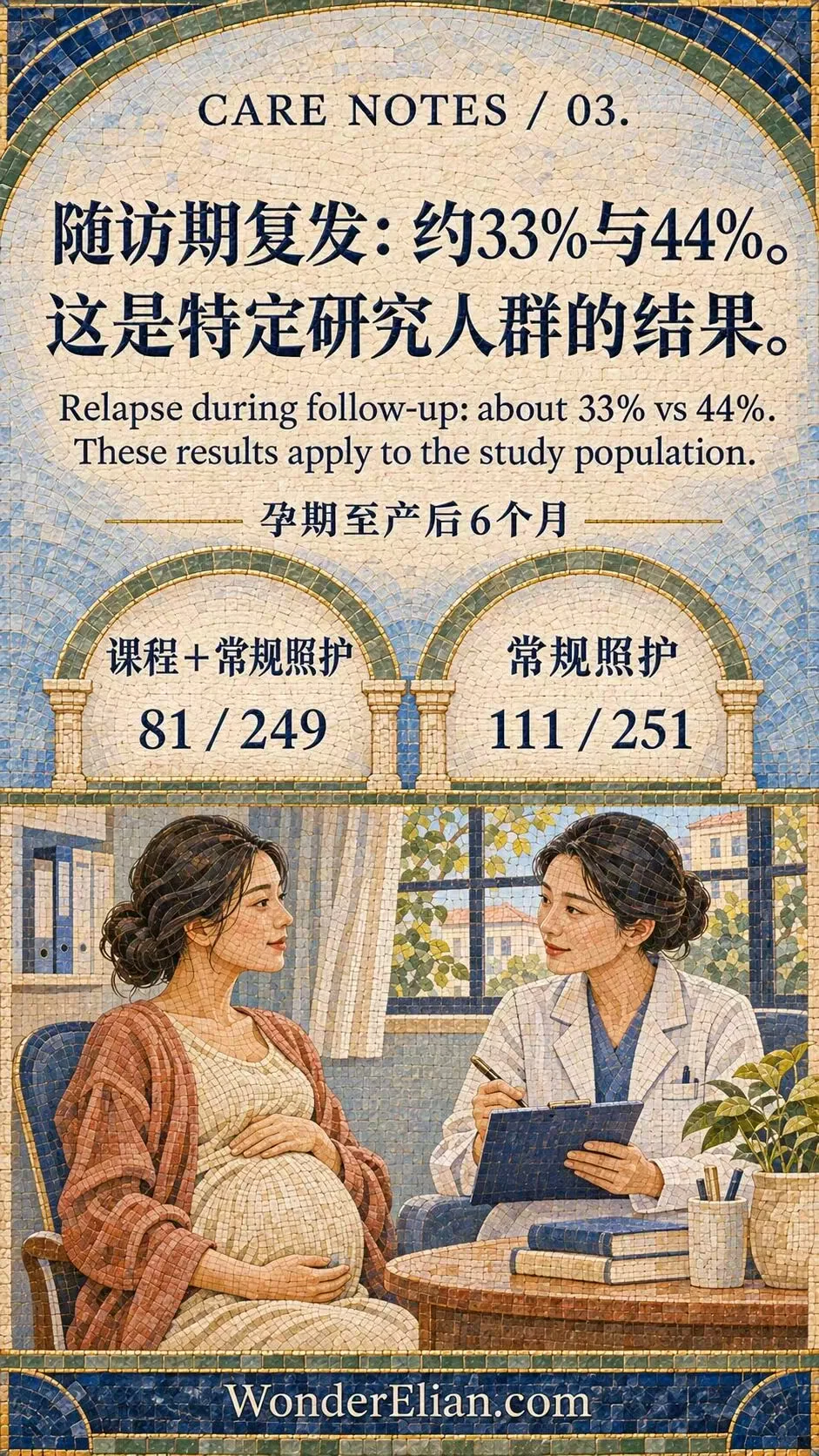
The “26% lower” figure in the news comes from a survival-analysis hazard ratio, or HR, of 0.74. In everyday terms, the analysis considered when relapse occurred during follow-up and estimated a relative relapse hazard approximately 26% lower in the course group. It does not mean a reduction of 26 percentage points, or that 26% of participants were cured.
The hazard ratio’s 95% confidence interval was 0.56–0.99, indicating uncertainty about the size of the effect. It provides evidence supporting this approach, rather than a basis for a definite guarantee.[2]
Another detail matters: approximately one third of the course group still experienced relapse. A preventive measure can help without preventing every episode. Relapse also does not mean someone failed to practice hard enough.
What Kind of Support Was Actually Tested?
The program is called Mindful Mood Balance for Moms, or MMB for Moms. It adapts mindfulness-based cognitive therapy to pregnancy, childbirth, and the early experience of motherhood.[1][4]
The trial offered a 12-week learning period with eight online sessions and periodic coaching check-ins. Material included guided audio, videos, exercises, and experiences shared by peers and professionals.[1]

The skills include noticing emotions and thoughts, responding to self-criticism, recognizing early signs of possible relapse, and seeking support when needed. Mindfulness here does not mean being required to stay happy or imagining real difficulties away.[1][4]
Consider a hypothetical everyday example. A baby keeps crying, and the thought arises, “I cannot do anything right.” One response is to keep blaming yourself. Another possibility is to notice, “I am very tired, and I am having a very harsh thought,” and then look for the next source of help.
This is an illustration of a skill, not an actual participant’s story or a complete therapeutic procedure. Its purpose is to show that people can learn ways to respond to distress without turning it into a judgment against themselves.
One detail must remain visible: the trial included coaching support. Its effect cannot be equated with downloading an arbitrary meditation app, listening to calming music, or watching a few videos alone.
Why “Non-Drug” Does Not Mean “Stop Medication”
This is the part I most hope will survive when the article is shared.
The university news release explicitly states that approximately three quarters of participants in both groups continued taking antidepressants during the study. The trial compared a course plus usual care with usual care. It did not randomly assign people to replacing medication with the course versus continuing medication.[1][3]

It can support adding an evidence-based non-drug option. It cannot establish that the course replaces medication, or identify who could safely discontinue medication.
Medication decisions when planning pregnancy, during pregnancy, and while breastfeeding require a person and their clinician to weigh previous illness, relapse risk, the particular medication, and individual circumstances. Seeing the phrase “non-drug” is not a reason to stop or reduce medication on your own.[5]
A wish to use less medication deserves serious discussion. A need for medication deserves support as well. Care should expand informed choices, rather than add shame.
Promising News, with Questions Still Open
First, the effect did not persist across every measure. The paper reported a greater improvement in depressive symptom burden during the course, but the between-group difference in improvement across the full observation period was not statistically significant. That can coexist with a lower relapse hazard: they are different outcomes.[2]
Second, 389 of the 500 participants provided assessment data at six months postpartum, approximately 78%. The study used an intention-to-treat analysis, but missing follow-up data remain a limitation to consider.[2]
Third, the control group received usual care without an equivalent schedule of course participation and coach contact. This trial alone therefore cannot separate the respective contributions of mindfulness content, attention from a coach, expectations about learning, and additional support.
Finally, the study concerned a particular U.S. population able to use English and online resources. Cultural context in Chinese-speaking communities, connections to local medical care, costs, and service availability need local evaluation. Follow-up extended only to six months postpartum. These findings cannot guarantee longer-term effects or benefits for children.[1][2][3]
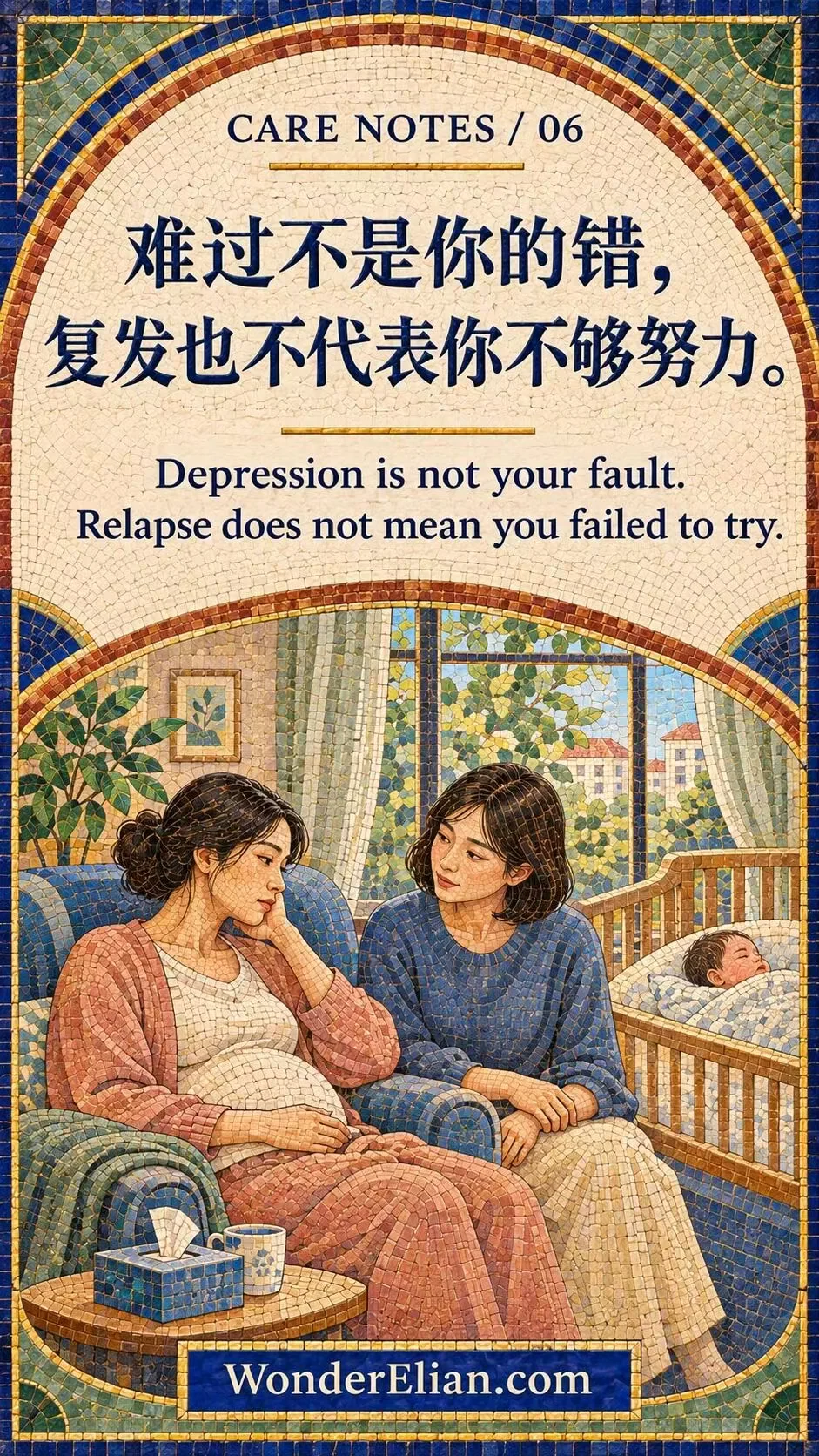
These boundaries do not erase the study’s value. They give hope a firmer footing and help prevent hope from becoming another demand: “You took the course, so why are you not better?”
What Can Mothers Plan Earlier?
If you have a history of depression, mental health can be part of conversations at prenatal appointments and follow-up visits, including when planning a pregnancy. Discuss how earlier episodes developed, which treatments helped, warning signs, available support, and whom to contact if your condition changes.[5]
This is not assuming that you will become ill. It is arranging possible care in advance, as you would organize other health information.
Together with a clinician, you could prepare a short plan:
- Early changes: Which changes in mood, interest, sleep, self-evaluation, or daily functioning should prompt attention?
- People to contact: Who will provide ongoing follow-up? How can appointments be arranged? How can care be accessed promptly if things worsen?
- Practical support: Who can take on specific childcare and household tasks? Who can accompany you to appointments?
- Treatment arrangements: What is the current plan, and who will be involved in decisions about changes?
This is a communication checklist, not a prescription for self-diagnosis or treatment. Preventive psychological support is also broader than this particular course. The U.S. Preventive Services Task Force’s formal 2019 recommendation supports providing or referring people at increased risk of perinatal depression to counseling interventions. The evidence mainly concerned cognitive behavioral therapy and interpersonal therapy. That recommendation is currently being updated.[6]
If symptoms have already appeared, timely assessment becomes the priority, rather than requiring yourself to finish a prevention course first.
Family Support Can Be More Concrete Than Reassurance
“Do not overthink it” or “Other people manage childcare” can make it harder for someone to talk honestly about how she feels.
Try beginning instead with, “I hear that this is difficult. Let us work out what could make things a little lighter right now.” Then turn help into practical arrangements.[5][7]

For example, take over a round of childcare, prepare a meal, handle housework, accompany her to an appointment, and create opportunities to rest wherever possible. Ask what she wants and agree on responsibilities, so that asking for help does not leave her responsible for directing everyone as well.
Rest and support matter, but they cannot guarantee that illness will not occur. When depression develops, family members can help with medical care and ongoing support, rather than argue, “We have helped you so much, so why are you still unhappy?”
A mother deserves care because she is a person worthy of concern, as well as because caring for her benefits her child.
When Is Professional Help Needed?
Brief mood changes after childbirth are common and usually ease within two weeks. However, if low mood, marked anxiety, loss of interest, self-blame, or difficulty coping persist, worsen, or interfere with eating, resting, or caring for yourself, contact an obstetric clinician, mental health professional, or another qualified health care provider for assessment. Severe symptoms do not need to wait until two weeks have passed.[5][7]
Difficulty sleeping even when there is an opportunity to rest, persistent feelings of worthlessness, and trouble bonding with the baby also deserve a serious conversation with a clinician. Questionnaires can help with screening and communication, but diagnosis requires professional assessment.[5][7]

If thoughts of harming yourself or someone else arise, tell a health care professional promptly. If there is intent, a plan, an inability to stay safe, or hallucinations, delusions, or marked confusion, go immediately to an emergency department or contact local emergency medical services. Ask a trusted person to stay with you and arrange safe care for the baby. Postpartum psychotic symptoms require urgent medical care.[5]
This is about making the route to urgent care clear when it is needed, without labeling anyone as dangerous.
Where Digital Tools Can Truly Help
What I see in this project goes beyond putting a psychological course online.
Its more important possibility is bringing structured skills and support to people who might otherwise struggle to get help. Time, transport, cost, caring responsibilities, and stigma can all stand in the way.[1][4]
Being digital does not automatically make a service effective or accessible to everyone. When a course says it is research-backed, ask: Was this exact program studied? Does it include human support? Who is it suitable for? Can it connect someone to medical care if their condition worsens? Do its promises exceed the evidence?
The official website currently provides an online course entry point. This article has not established whether people in China can use it smoothly, whether suitable Chinese-language support exists, or precisely which course and coaching services are free. It does not promise that the service is ready for those readers to use.[4]
As someone making products related to well-being, I remind myself that helping a person feel understood matters, and so does explaining what a product can and cannot do. An ordinary relaxation, companionship, or meditation tool cannot inherit the clinical effects of a particular researched program.

I hope more people see this news and take away more than a percentage.
A mother can receive preventive support while she is well, timely treatment when symptoms arise, and continued company during recovery.
She does not have to reach breaking point to deserve care.
This article provides general health information based on public sources. It is not intended for individual diagnosis, prescribing, stopping medication, or designing a treatment plan. Everyday scenarios are explanatory illustrations. The posters are artworks and do not depict actual trial participants. Research information was checked for the original article through November 4, 2026, using the abstract, trial registration and public results, institutional information, and authoritative health resources; access to the full journal article was limited. Discussion of the control design and applicability is the author’s interpretation.
The visuals use Byzantine Icon, the November 4 recommendation from Xiazi Style Atlas. Mosaic textures and contemporary family-care scenes provide an artistic treatment. No medical effect is attributed to a religious or artistic form.
Sources and Original Records
- 1. University of Colorado Boulder, via Newswise: Non-Drug Option Shown to Reduce Risk of Postpartum Depression, November 3, 2026
- 2. Dimidjian and colleagues, Outcomes of Mindful Mood Balance for Moms…, The Lancet Public Health, 2026; 11(11):e889–e899. DOI: 10.1016/S2468-2667(26)00184-2
- 3. ClinicalTrials.gov: NCT03623620, registration, eligibility criteria, and public results
- 4. Renée Crown Wellness Institute: official introduction to MMB for Moms
- 5. NIMH: Perinatal Depression, treatment and family support; revised 2023
- 6. USPSTF: Perinatal Depression: Preventive Interventions, formal 2019 recommendation, update in progress
- 7. NHS: Postnatal depression, reviewed March 2026
- 8. Xiazi Style Atlas, daily recommendation accessed November 4, 2026
- 9. Story lead: Xiazi Global Business Radar; the November 4, 2026 poster was supplied by the user. Research facts rely on the primary records above