I currently have six apps on Apple’s App Store, and I have also prepared H5 web experiences for them. After making the products, I ran into a major problem: I did not know how to promote them.
How do I help people discover them? Once they do, how do I help someone understand that a product may be relevant to their life? These questions deserve more attention from me than simply adding another feature.
Fastlane entered my research at exactly this point. What interested me was its attempt to turn promotion into a workflow that can be run repeatedly.
After Shipping, the Other Half of the Work Begins
In WonderElian’s “Along the Way” section, you can find Yixiu Meditation, Buer Within, Wendao, Xiazi, Style Atlas, and other work.[1]
I know why I made these products. Someone encountering one for the first time does not automatically share that context. They may not know what it is useful for, may not have the patience to read a full product page, or may not currently feel the need it addresses.
Promotion therefore has to answer a specific question: in what moment would someone remember this product?
A person whose mind will not stop at bedtime needs a different message, entry point, and reason from someone caught in a difficult relationship. A more complete feature list cannot replace that work.
He Also Built Apps and Then Struggled to Be Seen
Fastlane co-founder Gaurav said in an interview that he had built several apps and then became stuck on marketing. He and his partners built a company around that recurring problem.[2]
In an interview published on August 30, 2026, he reported that the software business had about $69,000 in monthly recurring revenue and more than 1,000 paying customers. These are founder-reported figures. They are not net profit and should not be read as current real-time revenue.[2]
Product Hunt confirms that Fastlane placed third for the day when it launched there on March 23, 2026.[3]
The case is commercially attractive, but Fastlane is a team venture. It should not be repackaged as proof that one person can casually build a tool and earn that amount every month. What matters more to me is that the company identified a problem I am also experiencing and will continue to face.
How Does It Connect the Marketing Work?
Fastlane’s current website presents Fastlane v2 as a workflow coordinated by an AI agent named Senna. It understands a brand from its website, researches the market, generates creative assets, publishes content, and uses results to adjust the next batch.[4]
The channels shown on its website include Meta, Instagram, TikTok, and YouTube Shorts. This is the official capability range presented by the company; actual availability still depends on the plan, account connections, and specific features.[4]
My H5 product pages may be useful here. When answering a mobile-app developer on Product Hunt, the founder suggested providing a more information-rich website first.[3]
A URL is only the starting point, however. If the page offers a brand story without clearly identifying the user, the situation, and the product value, AI can only generate more material from vague input. I still have to explain who the product is for, what it helps with, and what someone can try next.
The Design I Like Most: Begin with Choosing
In an early Fastlane demonstration, users could swipe through generated creative options and then schedule selected items for publication.[2]
I find that design intelligent.
A blank editor asks me to decide the topic, opening, format, and expression all at once. Several prepared candidates let me begin with judgment: Does this sound like me? Is the idea clear? Would I be willing to publish it?
AI handles more of the initial production while the person keeps the final choice. That lowers the barrier to beginning marketing and gives taste, tone, and honest product communication a place in the workflow.
If I build my own promotion tool, I would seriously borrow this principle. The interface could be different. The essential point is to make it easier to complete one good publication.
Why Can This Business Charge Repeatedly?
After an app launches, its value must still be explained, different messages need testing, and new people need to be reached. The need recurs naturally.
As of October 14, 2026, the main plans displayed on the website were as follows. Prices are in U.S. dollars and exclude any applicable taxes:[4][5]
Starter: $29 monthly; $20 monthly equivalent on the annual plan; 500 credits per month.
Growth: $79 monthly; $55 monthly equivalent on the annual plan; 2,000 credits per month.
Pro: $199 monthly; $139 monthly equivalent on the annual plan; 10,000 credits per month.
The annual equivalents require payment for a full year and are not month-to-month prices. The website lists a static creative at 5 credits and a video at 60 credits. Starter is also limited to one social account and one campaign at a time.[4]
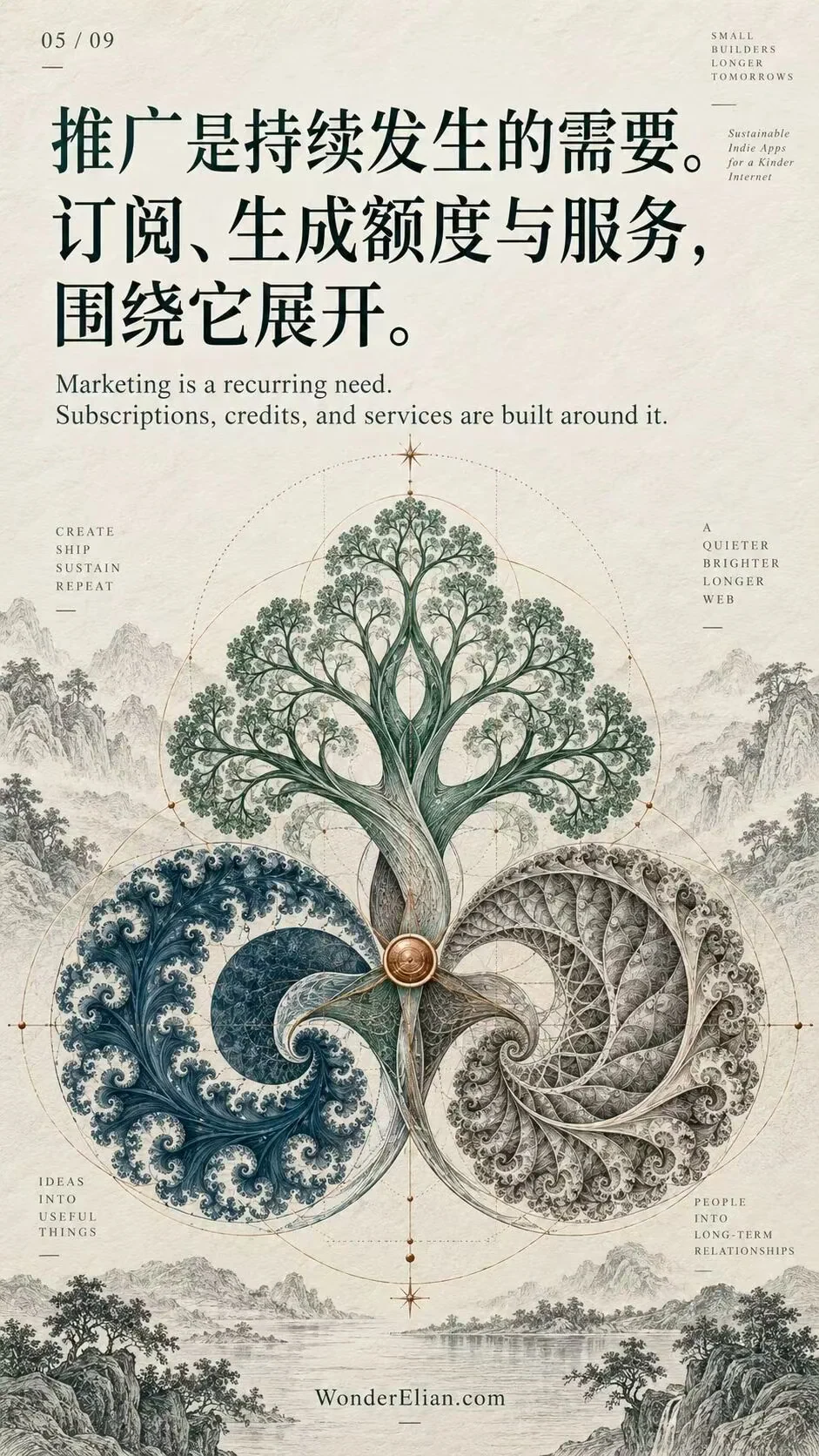
The business logic has three layers: a subscription for recurring use, credits for different levels of generation, and added services for customers who want more of the work handled for them.
Credits may also help control generation costs. Public information is not sufficient to calculate Fastlane’s actual gross margin, customer-acquisition cost, or churn. The revenue figure helps demonstrate demand; it does not show that the business is easy to run.
For my six apps, account, campaign, and workspace limits also matter. Paid distribution requires a separate media budget, while additional accounts and managed services add cost. The useful comparison is the total cost of completing an effective promotion cycle.
One trial detail deserves attention: the website describes a seven-day trial with 50 credits, while a video is listed at 60 credits. I should not assume the trial is enough to generate a video. The exact grant and access to video generation need confirmation before testing.[4]
Its Way of Understanding Users Is Also Worth Studying
In the interview, the team described offering additional usage time in exchange for user calls, then organizing that feedback into product decisions.[2]

For me, the useful lesson is to separate three observations: how people solve the problem today, how they actually use the product, and which people return over time and why.
“Do you like my product?” can easily produce a polite yes. Better questions are more specific: When did you last experience this problem? What did you do? Which step took the most effort?
If I eventually share my own promotion system, I want to observe how other people use it before rushing to add features I have only imagined.
Which Parts of My Work Could It Handle?
Based on its public description, Fastlane aligns with part of my situation: I already have product websites, I need to create promotion continually, and I want to reduce the production and distribution burden.
Its publicly listed channels are mainly global platforms. It does not currently present support for WeChat Official Accounts, WeChat Channels, Xiaohongshu, or Douyin. The global workflow may be worth testing; Chinese-market content and distribution still require separate validation.
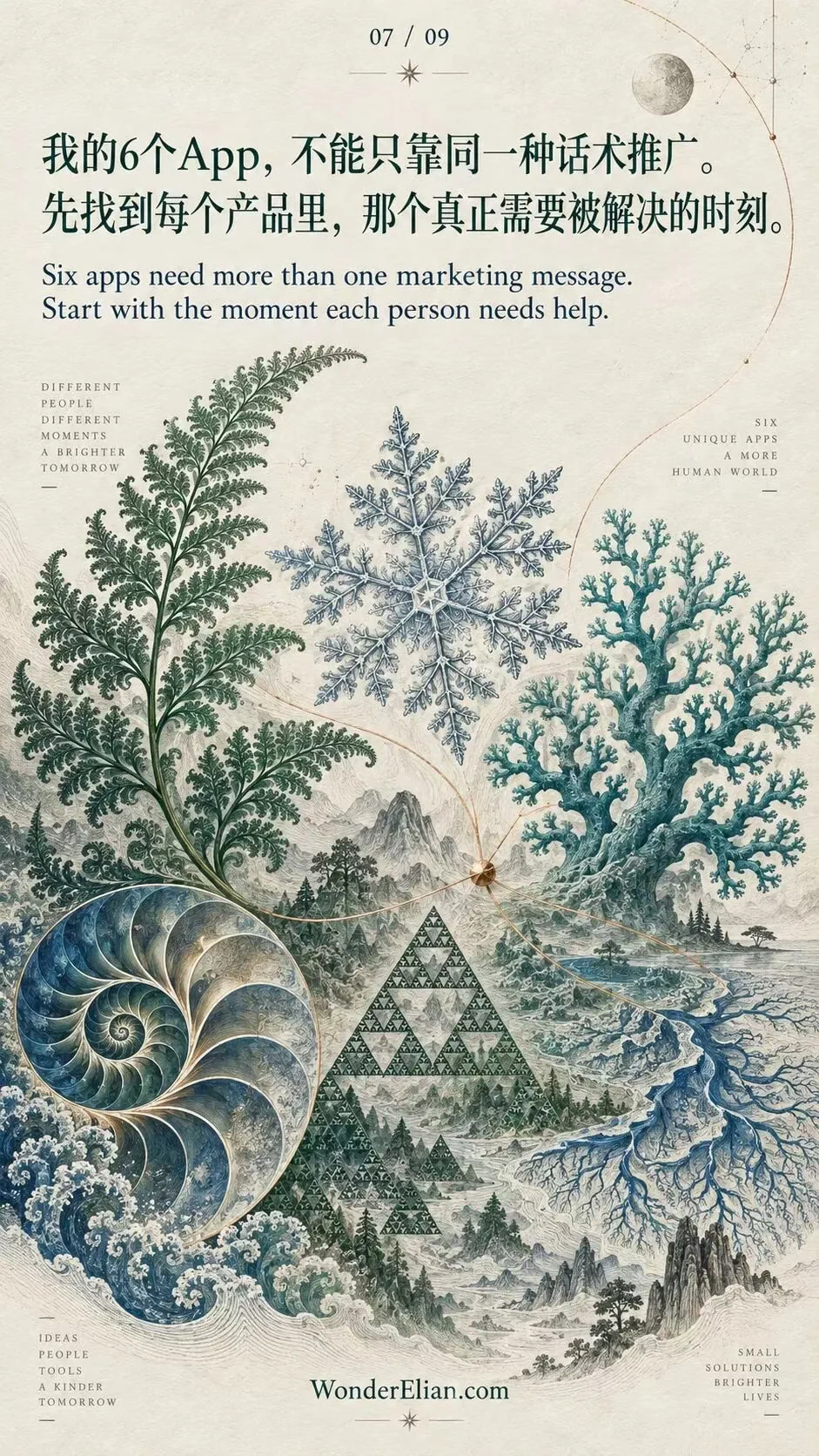
Six apps also mean different user needs. Yixiu might begin with the question of how to take a short pause in the afternoon. Style Atlas might begin with why one image feels more ordered than another. These are messages I want to test, not growth findings that have already been proven.
AI can help produce assets, but the experience described must remain accurate. I should not promote a feature that has not shipped or use invented customer praise as evidence. Fastlane’s terms also require human review and state that generated content is not guaranteed to be fully unique or free from third-party rights issues.[5]
High-view examples on the website are appealing. For my apps, the more useful questions are whether someone enters the H5 experience, completes a meaningful action, downloads the app, or pays. Views are only one stage of that path.
If I Build My Own, I Want to Begin with One Small Loop
My instinct is to meet my own need first, make the workflow genuinely useful, and then share it with people facing a similar problem.
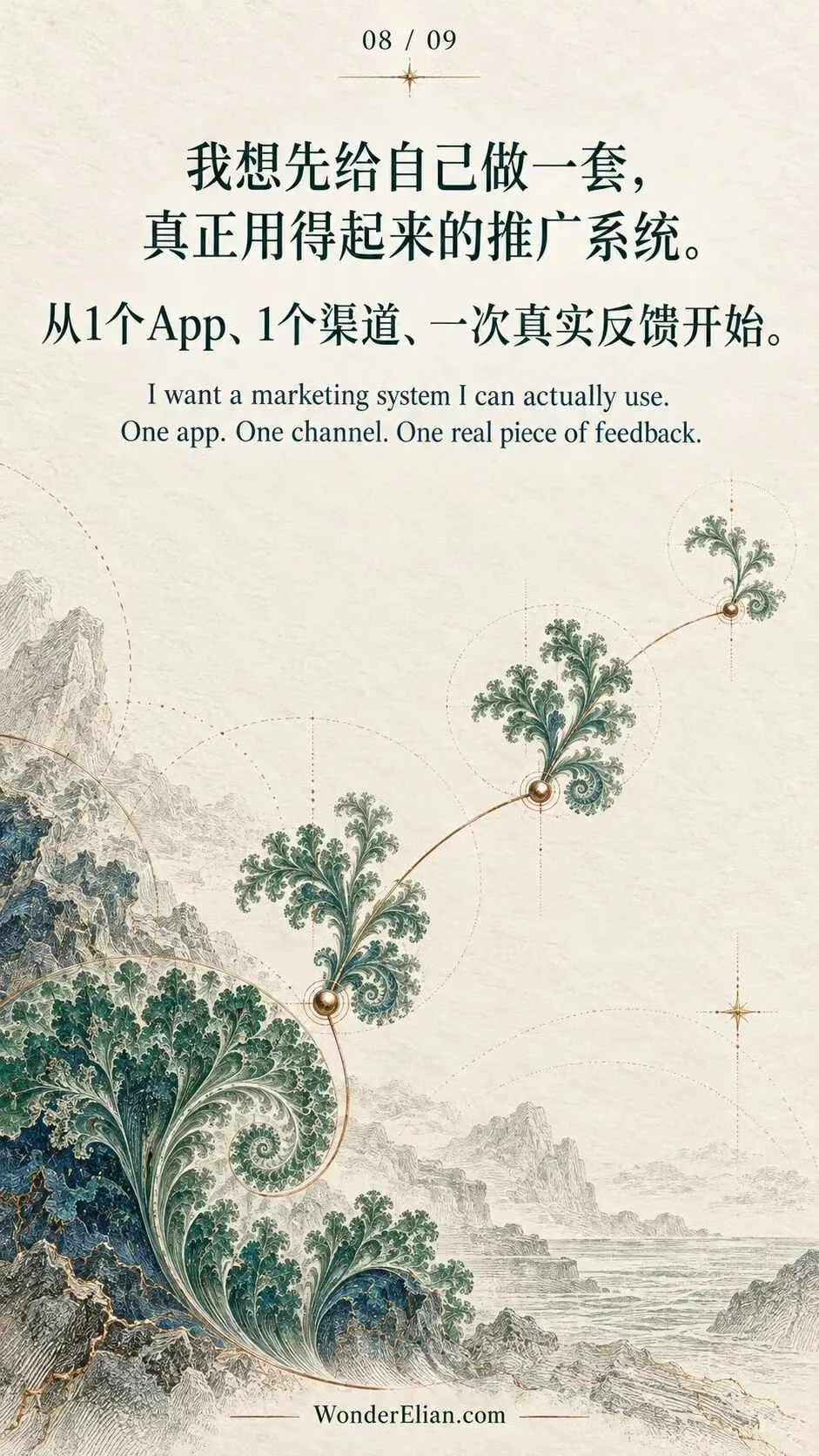
The first version can be small. Choose one app and one channel. Organize the product information. Let AI suggest several content directions. I select and revise one, schedule it, and bring the result back into the next round of topics.
The existing H5 pages can offer a low-friction entry point. Each piece of content can use a source-specific link so that visits and actual use can be observed. An App Store button click, a real download, an activation, and a payment are different events and must not be treated as the same number.
I also want to measure something else: how much work does this system actually save me each week? If it only produces a larger pile of material waiting for review and leaves me busier, it has not solved my problem.
Pricing should wait until recurring value exists. A subscription makes sense for someone who continually needs planning, generation, scheduling, and review. Someone who needs a single delivery occasionally may be better served by one-time pricing.
First make one path work. Then consider making it wider.
I Want the People Who Need These Products to Find Them
Fastlane showed me a direction worth studying: between creation and promotion, there can be a way of working that is easier to sustain.

I made these apps because I needed them and because I believe some problems in everyday life deserve thoughtful care. What I want to add now is a clearer way to introduce them to the right people.
Begin with my own pain point. Remove the difficulties I encounter in real use one by one. If the resulting system eventually helps people around me, I will be glad to share it.
I want to make the work, and I want the people who need it to see it.
This series uses the Fractal Art style recommended by Xiazi Style Atlas. Recursive branches, selection, and feedback loops represent product distribution and learning, making a complex promotion process easier to observe, choose, and improve.
Sources
- WonderElian: Along the Way. The count of six published Apple apps was supplied by the author.
- Starter Story: The Insanely Obvious Secret Behind This $69K/Month SaaS, published August 30, 2026. Revenue and customer figures are self-reported in the interview.
- Product Hunt: Fastlane, for its launch record and public replies from the co-founder.
- Fastlane official website, checked October 14, 2026 for features, prices, credits, and channels. Website demonstrations and customer examples do not guarantee individual results.
- Fastlane Terms, for human-review, generated-content, and fee terms.