CNY 11.41.
As one-person-company stories go, that number is hardly impressive. Other people share six-figure monthly revenue. Over here, even the decimal places deserve a careful mention.
But I really am happy.
Wendao, the app I made, has started recording paid transactions. The September report shows two sales and estimated total revenue of CNY 11.41.
The number is small. The feeling is very real: someone is willing to pay for something I made.

Not Much Money, but Zero Has Finally Moved
There is a peculiar feeling that comes with making your own product.
You think a feature is useful, an image looks good, or a passage is worth reading. At first, though, all those judgments come from you.
So a small question stays in the back of your mind: does anyone else need this?
A payment cannot answer every question. But it does give that question a little response from the outside world.
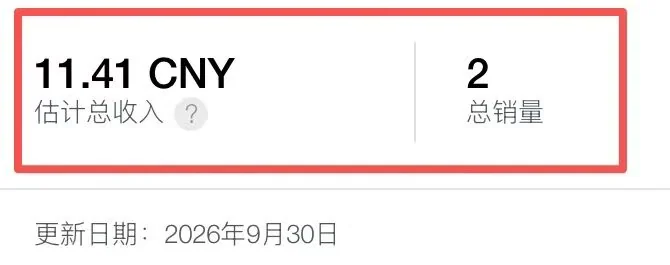
Of course, two transactions are not enough for me to declare that I have proved the business model. The dashboard says estimated total revenue; that is not the same as a final payout or profit.
Still, a small beginning is worth celebrating. I do not have to wait until it becomes big enough to allow myself to feel happy.
People who make products need data. They also need a little encouragement: “So this matters to someone after all.”
I Have Always Been the First User
Wendao is a reading app I built around the Tao Te Ching.
I read a chapter every day myself. I especially like the sections on what it can teach us and how the Tao appears in everyday life.
Reading an ancient book can leave you in an awkward place: you recognize most of the characters and can read the sentences, but once you close the book, how to live this particular day is still a headful of questions.
What I really want to understand is how these words relate to work, relationships, or the moments when I get tangled up inside myself.
So this product starts by meeting a need of my own.
That also gives me a very simple standard: Will I still want to open it tomorrow?
As its first user, though, I have a complaint.
The ideas are good. Reading one long stretch of text after another can still feel rather dry.
After a full day at work, my brain has already sat through eight meetings. When I open the app at night, could we please not schedule a ninth?
So I Wanted the Tao Te Ching to Feel a Little Like Stand-Up
Today I added comics to the “Tao Te Ching in Everyday Life” section.
I wanted to bring the feeling of stand-up comedy into the pictures: a familiar situation, a small reversal, and a moment of “Wait, that’s me.”
Rather than rushing to explain the whole lesson, first give people a reason to keep reading.
One comic is called “You Found Your Type. Don’t Rush to Climb into a Box.”
The main character takes a personality test. He sees “introvert” and “not good at public speaking” and immediately decides what that means for him: Friday’s team sharing session? Forget it. His type will not allow it.
Then, at lunch, the cook offers him a double helping of cilantro on his noodles.
Suddenly he has plenty to say:
“Once it goes in, the whole bowl belongs to cilantro!”
The man who just said he was not good at expressing himself encounters cilantro, and his ability to speak comes roaring back.
His colleague asks, “Why didn’t your personality type stop you just now?”
He replies, “Maybe it doesn’t eat cilantro either.”
I like this kind of joke. After the laugh, the question lingers: how often do we use a label to close a door on ourselves before we even try?

Open the original comic at full size

Read the comic in English
01 · Sunday evening: an idea. A work-group message asks who would like to speak at Friday’s lunchtime sharing session. He thinks, “That pothos I’ve grown to look like leftover noodles has a story to tell.”
02 · Taking a test. The result says “introvert,” “not good at public speaking,” “prefers being alone,” and “tends to think deeply.” He says, “Wait—the test says I’m not good at expressing myself.”
03 · Boxing himself in. Sitting inside a box marked “introvert,” he decides, “Then forget it. My type won’t allow it.”
04 · An invitation from a colleague. She asks, “Don’t you have a story about your pothos?” He replies, “The story is available. The person might not be.”
05 · Lunch: the trigger. The cook says, “Double cilantro for you!” He jumps in: “Wait! I need to say something about this!”
06 · His mouth suddenly switches on. “Once it goes in, the whole bowl belongs to cilantro!” Three minutes later, the cook says, “Understood. Not a single leaf.”
07 · After lunch. His colleague asks, “Why didn’t your type stop you just now?” He says, “Maybe it doesn’t eat cilantro either.”
08 · Walking back to the office. He says, “But I still get nervous onstage.” She suggests, “Then talk about something you know. Just three minutes.”
09 · That evening. He prepares notes about his plant: how he cares for it, how it is doing, and that he has not given up yet. “Taking three photos is better than taking a box.”
10 · Friday lunchtime. “Hello, everyone. I…” He is still nervous. He has not run away, either.
11 · A three-minute talk. “I wanted to grow a forest. Instead, I grew a bowl of noodles.” His colleague asks, “Did you bring it back to life?” He answers, “It’s still trying. Rather like me.”
12 · Back home. “That was quite a lot of talking today. Tomorrow, I’ll have a little quiet.” A note reads: “Labels are notes, not seals.” The closing line says: “Names have their uses; know where to stop. You do not have to accept every label in full.” This is a contemporary reflection inspired by Chapter 32, not a quotation of the original chapter.
Labels Are Notes, Not Seals
I did not want this story to say that introverts must become extroverts.
The character eventually prepares just three photos and speaks for three minutes. He is still nervous when he stands up. When he gets home, he still wants some quiet.
He has not suddenly become someone else.
His “I can’t” has simply become “Then I’ll try saying a little.”
Labels can help us understand ourselves. We can also use them to limit ourselves.
“I’m an introvert.” “I’m not good at expressing myself.” “At my age, I can’t learn new things.”
Sometimes a description gets repeated until it becomes a notice saying: no entry.
The comic draws on Chapter 32 of the Tao Te Ching, particularly its discussion of naming and knowing when to stop, to imagine a situation in contemporary life. It is a creative extension, not a claim that the original text is about personality tests.
What I want to leave with the reader is simple:
Labels are notes, not seals.
If a comic can make someone laugh and then treat themselves a little more gently, I think this way of telling a story is worth continuing.
After Two Payments, Keep Making Things Slowly
Next, I plan to gradually add comics like this for all 81 chapters.
That is a plan for what comes next, not a list of work already completed.
More than rushing to reach a number, I want each chapter to find a scene that feels alive. Something people want to read, smile at, and pause over as they think about themselves.
The payments have encouraged me. The comics have given me a new way to express these ideas. Next, I still need to see what it is actually like for other people to use them.
I want to make products that help people catch their breath when life is difficult, and appreciate its good moments when things are going well.
Making things can also be a way of caring for ourselves, understanding other people, and finding a little connection with the world again.
Right now, the dashboard shows estimated total revenue of CNY 11.41.
Today also brought one more way to make ancient words a little more engaging.
Two small things. Together, a very good beginning.
Slow down. Take your time. Grow into who you are.
Have you ever earned a very small amount that stayed with you for a very long time?
The cover draws on the exaggerated 3D cartoon-comedy style featured today in Xiazi Style Atlas. The comic in this article is actual content from Wendao. Trying another way of drawing is also a way of practicing visual judgment and expression.