What Comes After Being Able to Build?
Have you ever felt this way? You can now make things you could not make before, yet earning a living from them does not seem much closer.
The website is live. The app is in the store. The content is published. You have finally crossed the technical threshold, only to discover three more questions on the other side: Who needs it? Why should they trust you? Why would they pay?
AI makes building easier. It also makes deciding what is worth building more important.

This does not mean professional skills are obsolete. I see it as a shift in emphasis for entrepreneurs and independent business owners. What matters includes what you can deliver through the resources you organize, and whom those results actually help.
The First Skill: Judging What Is Worth Doing
Imagine a small shop owner saying, “I want a membership system.”
You could immediately ask AI to build pages, connect payments, and add reward points. But after a longer conversation, you discover the real concern: regular customers are returning less often, and staff cannot remember what each person last bought.
The most valuable decision might be to start with a usable customer follow-up list and investigate why people stop returning. Whether a complete system needs to be built comes later.

Professional judgment means seeing the problem behind a request. It also means knowing what does not need to be done yet.
Who encounters the difficulty, and in what situation? How do they deal with it now? What does it cost them in time, money, or emotional strain? Is your proposed approach better than their existing options?
AI can organize information and suggest hypotheses. A beautifully presented requirements report cannot replace feedback from real users.

Expertise remains the foundation. Knowing a field helps you decide what to trust, what to check, and where to stop.
Someone unfamiliar with design can easily mistake visual excitement for good design. Someone unfamiliar with a business can mistake working software for a solved problem. As execution becomes easier, differences in judgment become more visible.
The Second Skill: Getting Things Done with AI
Knowing how to ask AI a question and getting it to deliver reliably are different abilities.
“Build me a useful product” sounds like a task, but it still lacks a user, a scope, constraints, and acceptance criteria. When the task is vague, AI may diligently complete something you never needed.

To me, managing AI means breaking a goal into deliverable steps: what information to gather first, which version to make next, which steps can run in parallel, what counts as a pass, and how to correct errors.
Microsoft’s recently released Agensh research explores how multiple agents can claim tasks, share information, verify results, and merge their work. It shows that coordination mechanisms deserve investigation. It does not prove that opening more AI agents is equivalent to hiring more excellent employees. A research coding benchmark is not a company’s business performance.[1]
Managing AI also requires accounting for time, cost, and rework. When one tool can finish a task, there is no need to add ten more simply to display an impressive lineup.
Acceptance checks need to be specific. Can the sources in an article be opened? Does the purchase flow work? Has user data been exposed incorrectly? Can a customer use the result independently after receiving it?
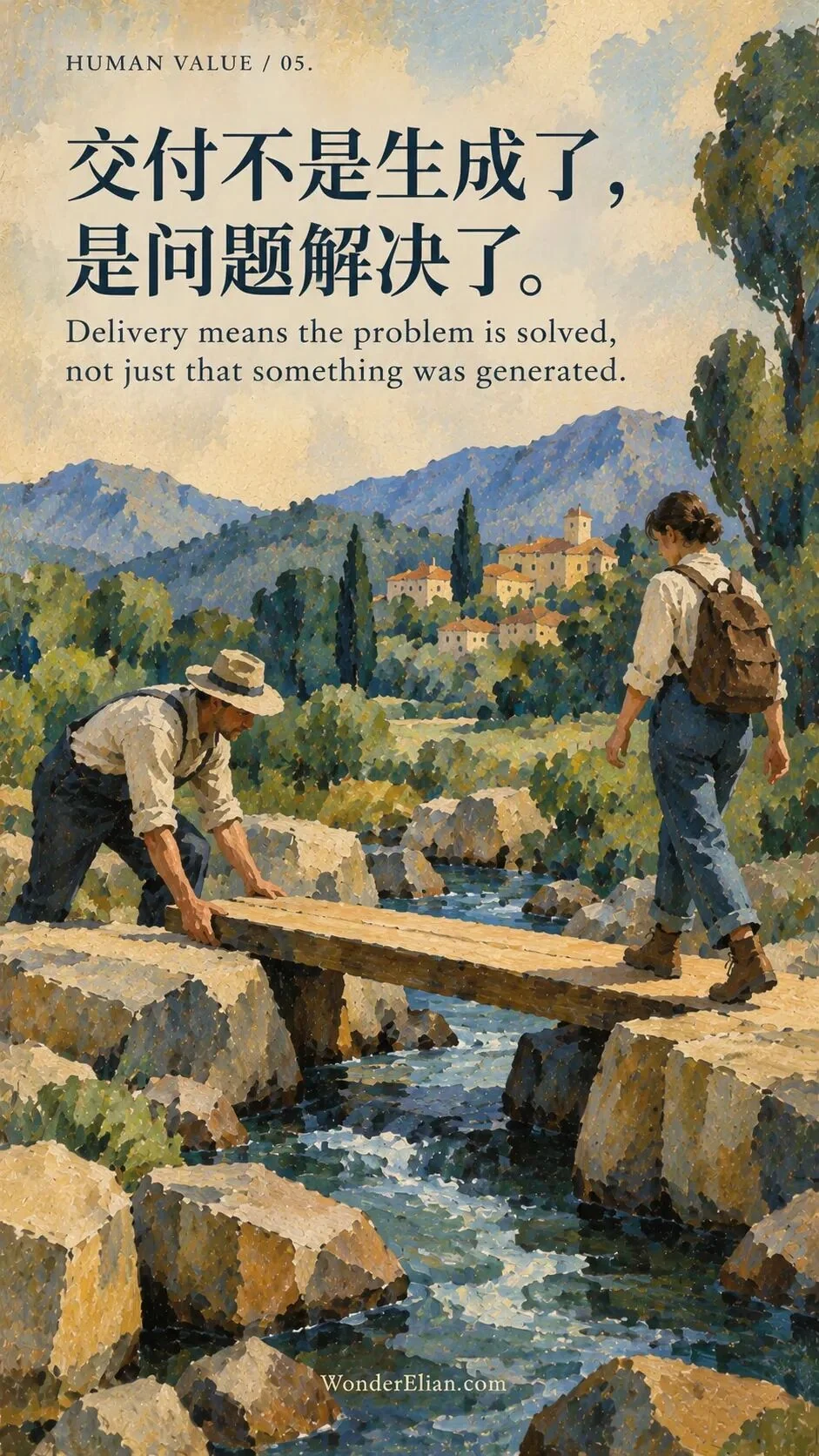
The standard for delivery should be whether the problem has been solved, beyond whether an output has appeared on a screen.
AI can take on more execution. People still need to take responsibility for commitments and mistakes.
The Third Skill: Making Value Understood and Realized
Many independent developers are willing to spend a week polishing a feature, but struggle to ask a stranger, “What trouble is this causing you right now?”
Code offers visible progress. The market may answer with silence. So we keep adding features, as though a more complete product could spare us the possibility of rejection.
After developing several apps, I understand that gap more clearly myself. Once something is built, promotion, customer acquisition, and commercialization are things I still have to learn.

The sales ability I mean includes finding suitable customers, understanding their circumstances, explaining the value clearly, offering credible evidence, setting a reasonable price, and keeping your promises.
Making your own short videos involves the same work. Instead of repeatedly showing buttons and features, demonstrate how a particular person, in a particular situation, can avoid one specific difficulty by using the product.
Communication is useful, but it can only amplify real value. If the product cannot fulfill its promises, stronger selling may produce more refunds and disappointment later.

For an independent business owner, a more complete path is to identify a need, test willingness to pay, define the promise, deliver the work, confirm that the customer received value, and then seek repeat business or referrals.
Payment is a signal, not the whole answer. Delivery costs, refunds, actual use, and reasons for returning matter too. Some products are naturally one-time purchases. Customer satisfaction and willingness to recommend them may matter more than insisting on a subscription.
Will Sales Replace Expertise as the Most Important Skill?
My view is that sales is becoming more important for independent business owners. The broader ability worth measuring is whether someone can keep creating, delivering, and realizing value.
If you can only build, the value may remain unknown. If you can only sell, the promises may go unfulfilled. Professional judgment, AI management, and sales need to connect.

If you want to start practicing tomorrow, choose a small enough problem. Speak with a few real users and record how they handle it now. Ask AI to help you build a minimal version. Then return with a clear price and delivery scope, and ask whether they want to use it.
Work through the numbers: what the customer receives, how much time you spent, the costs of tools and maintenance, and what still needs improvement.
One small delivery whose results can be checked says more about business ability than claiming to have ten AI employees.

These standards concern running a business. They do not define a person’s entire value. Research, education, care, and many forms of long-term work cannot be measured solely by immediate income.
You do not need to force yourself to run ten projects because AI has become stronger. Begin with something you truly care about. Help one specific person, and gradually build a business of your own.
Tools let one person do more. Judgment determines where that effort goes. Responsibility determines whether others will want to trust you with the work again.
The visuals use Cezanne / Cézanne-inspired structure, the October 31 recommendation from Xiazi Style Atlas. Weighty blocks of color, restrained brushwork, and forms that support one another express judgment, collaboration, and trust. The nine posters were generated with ChatGPT as artistic expressions of the essay’s ideas.
Sources
- 1. Microsoft: Agensh official project and research notes. Open-sourced October 24, 2026; support for additional agent backends announced October 29. Cited here as research into agent collaboration, without inferring general productivity or commercial returns
- 2. Xiazi Style Atlas, daily recommendation for October 31, 2026
If you are also learning to turn ideas into products, and products into a business, I would be glad to exchange experiences.