The reason I began making these apps is quite simple: I wanted to use them myself, but I could never find anything that felt quite right.
There are plenty of products already. Yet the content, pace, and way of using them that matter to me are not always considered.
In the past, that thought might have ended with, “I wish something like this existed.” With AI, I can now try making it myself.
As I kept building, I realized that I was also changing the way I live each day.
Recently, there is one part I have wanted to develop more carefully: the people close to me.
Little by little, I am adjusting life so that it fits me better.

Could Life Ask Us to Settle a Little Less?
In my previous essay, I wrote about building several products with AI and slowly piecing together the life I want.
Every day, I rest with sounds from Yixiu Meditation and read a chapter in Wendao. I am the user, so ordinary life answers whether something feels natural and whether I want to open it again.
These needs are not grand, but they are real.
I want to read without making it feel like homework. I want to look at the world and notice opportunities that have something to do with me. I want work to run more smoothly while still leaving room to rest.
Life does not always fit the default settings of software.
Some people like to fill every part of a day; others need open space. Some enter an idea through words; others only understand it when they see a story from ordinary life.
I want to make tools that fit me more closely, then keep adjusting them through use.
Product makers often talk about “understanding the user.” When I am the user, I can listen carefully to my own needs too.
Even the People We Know Well Are Worth Knowing Again
While refining Buer Within, I have become increasingly interested in its space for “People Around Me.”
Learning about ourselves naturally leads to another question: how do I live with the people I care about?
Parents, partners, children, friends, and colleagues—many of our daily feelings arise inside these relationships.
Imagine that your partner comes home and says, “My boss is being an idiot again...” You immediately analyze the cause and list possible solutions. Every suggestion may be correct, but the person speaking may simply want to be heard for a moment.
You have already reached solution number three before their hurt has finished its first sentence.
That kind of mismatch makes me think it is worth spending time learning about one another again. Familiarity does not mean permanent understanding, and care still has to arrive in a form the other person can receive.
We are willing to study how tools work. We can also ask the people beside us from time to time: what kind of support do you need right now?
Make Room to See the People We Care About
A page I am currently refining begins with this line:
Understand each other, and bring a little more ease into the relationship.
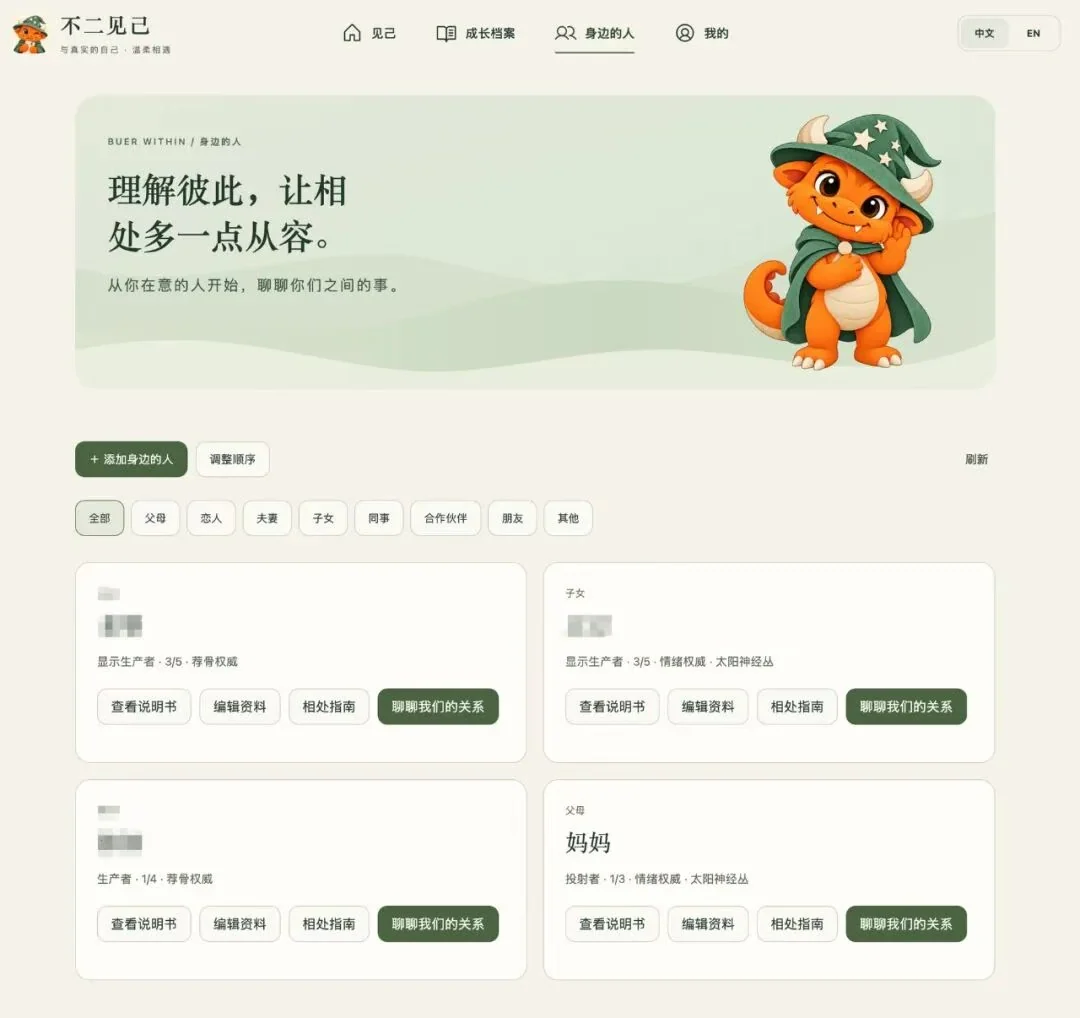
I want this entrance to bring me back to a specific person and a specific moment. What just happened? What matters to me? Was there something one of us still had not expressed clearly?
It can become a place to organize thoughts and prepare for a conversation. Real understanding still has to return to what each person says.
The “guide” on the page should not become a verdict stamped onto someone. No type or interpretation can contain a complete person.
A tool can remind me to ask one more question. The answer still has to come from listening to the other person.
This part remains in development and has not been formally released. I want to find a comfortable way for it to help when needed—and then let people return to life with a little more ease.
Begin with One Small Thing You Have Tolerated for Too Long
“A tailored life” sounds like a large idea. In practice, it can begin somewhere very small.
You do not need to make an app. You might adjust one work process, change the way you read, or make an agreement with your family: when someone needs to talk, listen until they finish before offering advice.
If you want to try, begin with three sentences:
- What small thing have I been tolerating for too long?
- What would make it feel natural and comfortable for me?
- Could I change just one part of it today?
A more specific question makes it easier to begin. Instead of “I need to be more efficient,” try, “Whenever I need the previous file, I spend ages searching through old chat messages.”
Try one small solution. Use it a few times, then decide whether it deserves to continue.
Products work the same way. My own need gives me a reason to begin. Turning that need into a business still depends on whether other people share it, use the product, and choose to pay.
I want to listen to that feedback while preserving the joy of making something myself.
Tailor life a little more closely: make work easier, rest more peaceful, and leave more room when you are with the people you care about.
Yixiu, Buer, Sanman. Make things gradually, and learn how to be with one another gradually too.
What small part of your life would you most like to redesign?
The illustrations draw on the Graphic Novel style recommended by Xiazi Style Atlas, using a sequence of everyday scenes to trace the movement from tools toward people.