
Today, I came across a poster in Xiazi · Yesterday’s World.
The largest number on it was $4 million in profit.
The person behind that number is Justin Welsh. He has turned his experience in sales and entrepreneurship into courses, consulting, content sponsorships, and subscription products, running a one-person business with almost no formal employees.
That alone is enough to catch your attention.

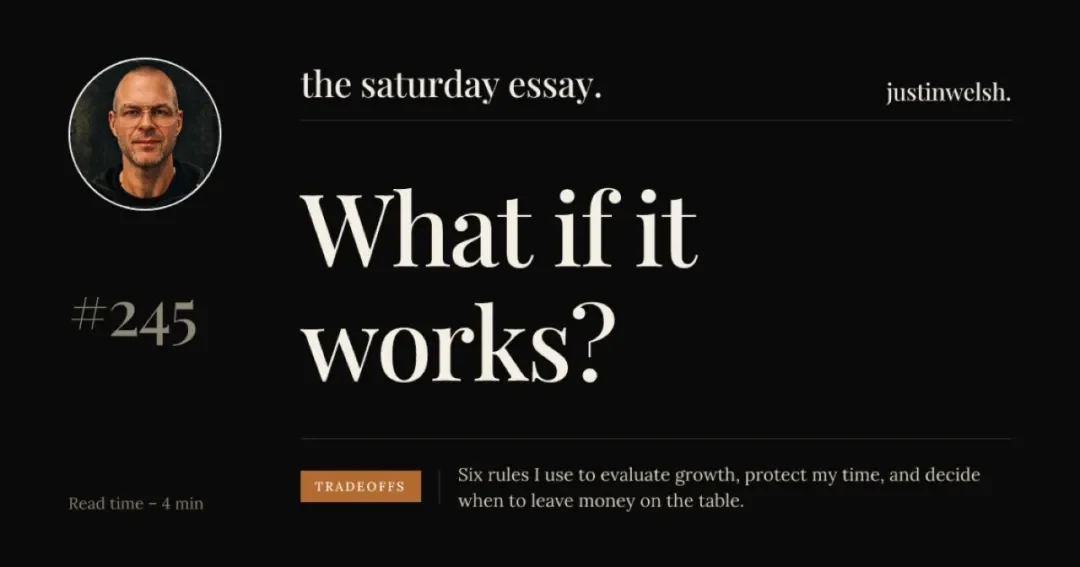
But after following the link on xiazishuo.com to his own website and reading his recent essay, What if it works?, I realized that the number was not what moved me.
Quite the opposite.
Justin writes that 2024 was his business’s peak, with more than $4 million in annual profit. He may never reach that figure again, and he has no interest in rebuilding a team, adding meetings, and taking on management work to get back there.
Someone who has built a one-person business on that scale is now asking a different question:
If an opportunity really works out, will it give me the life I want?
That interests me far more than “How do I make $4 million?”
Before he became a model solopreneur, work had knocked him down
Justin did not begin by wanting to be a creator.
He spent more than a decade in sales before joining SaaS startups, helping two companies grow to valuations above $1 billion. At PatientPop, he led a sales team of more than a hundred people through rapid growth.
On a résumé, it looks like the standard curve of success: a higher title, a bigger team, better numbers.
His body was producing a different report.
According to his own account, he suffered a severe panic attack on December 16, 2018. Prolonged work pressure, a loss of control, insufficient sleep, and unhealthy habits had accumulated. At one point he thought he was dying, and his wife called emergency responders.
The next day, he asked to leave his management role. He stayed for roughly nine more months to complete the handover, then brought his career as a technology executive to an end.
This was not a carefree story about quitting a job.
He had a mortgage and no certainty that his new business would work. When the pandemic arrived, he even wondered whether leaving to work for himself had been an expensive mistake.
But the panic attack forced him to confront a harder question:
If what we call success is turning life into something we do not want, is it still success?
He started by writing about his experience, before building a product
After leaving, Justin did not immediately design an ambitious course or start with a business model canvas.
He began with something ordinary: consistently writing about what he actually knew.
On LinkedIn, he shared his experience in SaaS sales, team building, and entrepreneurship. There was no elaborate content strategy at first. He kept expressing his ideas, watched which questions drew responses, and used that real feedback to decide what to write next.
Then things happened step by step.
Founders asked him for sales advice, so he began consulting.
People kept asking how he used LinkedIn, so he turned his method into a small $50 course.
He noticed that he was making content templates every week, so he offered them as a monthly subscription.
With an audience that read him regularly, he started a newsletter and added sponsorships.
Recurring questions gradually became courses, templates, subscriptions, and more content.
There is no dramatic flash of inspiration in this path.
It looks more like a simple cycle:
Write about experience → Attract people with similar interests → Answer questions → Discover needs → Make products → Keep writing from customer feedback.
He did not first guess at a market and then search for people to buy. He built trust by sharing his thinking in public, then made products out of problems he repeatedly helped people solve.
In his public retrospective in 2025, Justin said his business had passed $10 million in cumulative revenue over five years and nine months. Products, consulting, sponsorships, subscriptions, and a community were the main sources of that revenue. He reported a profit margin of roughly 89% and said he had used no paid advertising throughout that period.
“One-person business” does not mean doing everything alone. He also explained that his wife helped extensively, an outsourced virtual assistant handled customer service, and he worked with specialists when needed.
What he rejected was rebuilding an employee organization that he would have to manage over the long term.
What impresses me most is that he has closed profitable businesses
People often describe one-person businesses in terms of low overhead, high margins, and the compounding value of content.
Something else in Justin’s experience matters more to me: he will close a business that does not fit the life he wants.
He once ran a creator community generating about $15,000 in monthly revenue. Commercially, it was not a failure. The problem was that it made him feel he had to be in Slack all the time.
That was precisely what he had left his previous job to escape.
So, 15 months after launching the community, he shut it down.
The decision may be difficult to explain in a spreadsheet. Why not keep growing a product that is making money?
Add “the life I want to lead” to that spreadsheet, and it suddenly makes sense.
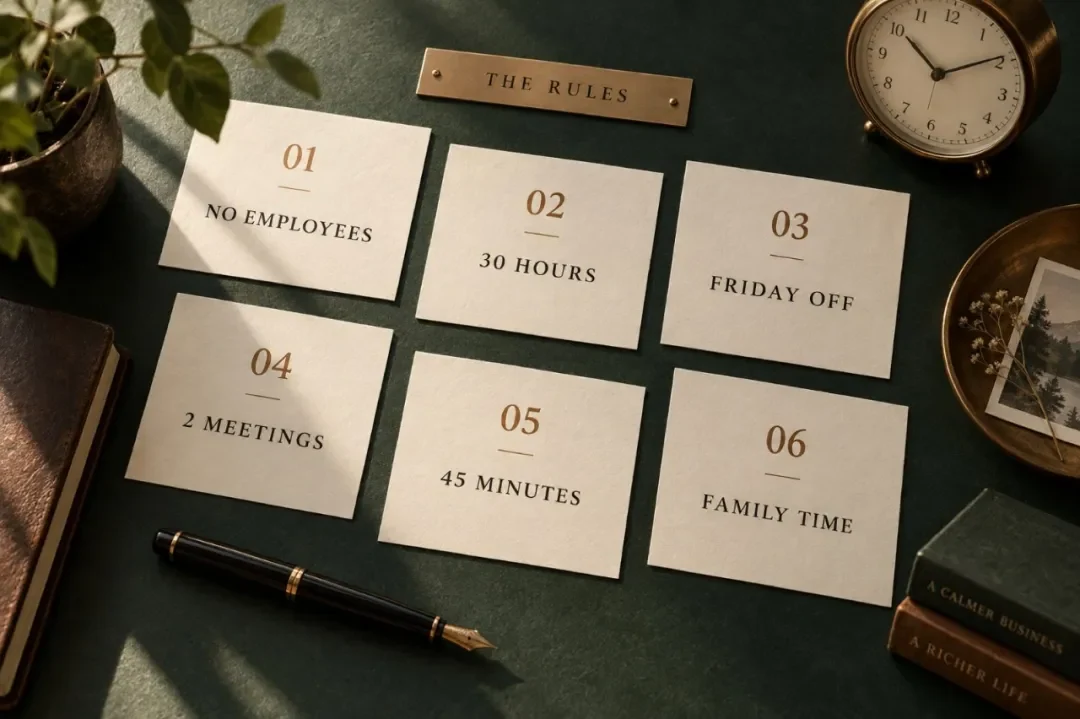
In 2020, Justin wrote down six boundaries for himself:
1. Do not manage employees.
2. Work no more than 30 hours a week.
3. Keep Fridays as free as possible.
4. Have no more than two meetings a day.
5. Keep each meeting to 45 minutes or less.
6. Protect evenings and weekends with family from work.
When people encourage him to buy ads, hire a content team, build a membership, or run events, he considers more than whether he could make another million dollars.
He also asks: if this becomes very successful, what will I have to do every day?
An opportunity can work exactly as planned and still leave you running a company you never wanted.
A one-person company should not turn you into ten people
It is easy to treat a one-person company as another endurance challenge: write content, build products, answer customers, edit videos, run ads, manage the accounts, and ideally fix the server along the way.
The company has only one person, yet it inherits plenty of organizational problems. Meetings become to-do lists. The boss and the employee live in the same head, and neither gets to clock out.
Justin Welsh’s experience reminds me that the point is not to do absolutely everything yourself.
It is to use content, software, digital products, and outside collaboration to deliver the same capability many times, while keeping the right to decide where your company’s boundaries lie.
His core asset is not any single course, either.
What keeps compounding is the content accumulated around a consistent subject, readers’ trust, relationships through email, and an increasingly accurate understanding of the audience’s problems. Products and channels can change. Those assets can travel with him into the next experiment.
That is a different proposition from making one hit product and then earning money in your sleep.
By the time of that 2025 retrospective, he said he had written more than 5,000 pieces of content and lived through plenty of worry and sleepless nights. He also explicitly warned readers that he is an unusual case, that a creator business is difficult, and that his path cannot simply be copied.
The numbers on the poster are large. The time behind them is long.
A question to ask before “How much do I want to earn?”
After reading Justin’s story, my immediate response was not to copy his courses, newsletter, or sales funnel.
I wanted to write a list of my own:
What work am I willing to repeat over the long term?
What do I not want filling my days?
How many hours can I work each week and still feel that my life belongs to me?
Which sources of income look attractive but would return me to a state I dislike?
If an opportunity succeeds, what will it add to my everyday life?
Many business plans begin with markets, products, channels, and revenue.
Perhaps they need another page: How do I want this company to let me live?
The most worthwhile part of Justin Welsh’s story is not the scale of the numbers he has achieved.
It is that, after experiencing a loss of control, he began designing his company in reverse: first identify what he does not want, then decide which kinds of growth are worth accepting.
Income matters, of course.
But the best version of a company may not be the version that makes the most money.
It may be the one you still want to run yourself when you wake up each morning.
My answer: Yixiu · Buer · Sanman
Justin’s experience reminds me that work and life will never remain at their peaks forever. What matters may be less about avoiding every low point than about knowing how to care for ourselves, understand ourselves, and keep creating through change.
This is an attitude toward life that I am becoming more certain of:
We hope to accompany one another through life’s lows and highs, exploring ways of working and living that support both body and mind; to face ourselves and the world honestly, treat ourselves, others, and all life with kindness, and discover life’s beauty through creating and appreciating.
Yixiu · Buer · Sanman
Yixiu — Rest: Care for the body and settle the emotions before moving forward.
Buer — Non-duality: Without judgment or dividing experience into good and bad, right and wrong, accept both highs and lows. Embrace wholeness rather than perfection.
Sanman — Slow down: Slow down, take your time, and become yourself gradually.
Like water: Put down roots within and flow outward. Adapt to change without losing your center.
Sources · September 21, 2026
The figures and experiences discussed here come primarily from Justin Welsh’s public accounts. Revenue, profit, and audience figures have not been independently audited for this essay.
[1] What if it works? · September 12, 2026.
[2] My complete $10M journey · June 7, 2025.
[3] My $4.8M Social Media Sales Funnel · October 14, 2023.
[4] Justin Welsh’s public account of his panic attack in 2018.
The poster that prompted this essay comes from Xiazi · Yesterday’s World. The cover and rules illustration were created with AI assistance. The figure on the cover is a conceptual character, not a portrait of Justin Welsh.